
Amazon PPC case study | Tools and hardware
How a complex tools catalog grew Amazon sales 63% in four months.
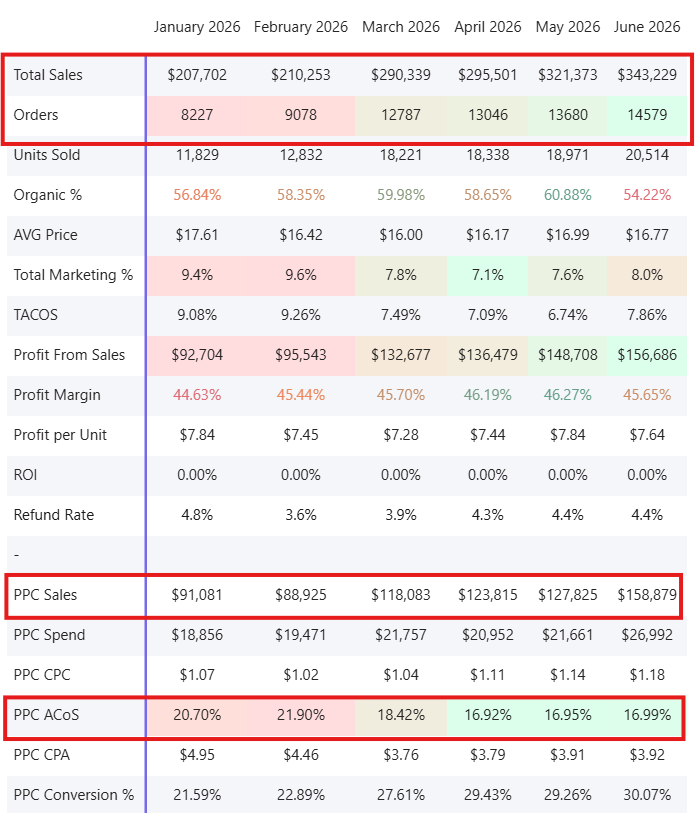
IZC Media rebuilt the Amazon PPC account around parent ASINs and product families. From February to June 2026, total sales increased from $210,253 to $343,229, while PPC ACoS improved from 21.90% to 16.99%.
The account did not need more disconnected campaigns. It needed a structure that showed which products were working, where advertising coverage was incomplete, and which families had room to scale.
Client name withheld for confidentiality. Data shown covers January through July 2026. Results are specific to this account and are not guaranteed.
The problem
The catalog was large, but the PPC structure hid product-level opportunity.
The account contained many tools, parent ASINs, and deep variation families. It was producing sales, but it was not creating meaningful growth. Broad campaign organization made it difficult to tell which families deserved more budget and which parts of the catalog were being underused.
Account-wide ACoS could describe the average. It could not explain what each product family needed next.
Incomplete product coverage
Important parent ASINs and variations did not have a clear place in the advertising structure.
Blended performance signals
Account-level reporting obscured which product families were efficient, constrained, or ready to scale.
No repeatable growth system
Campaign activity existed, but budget could not be allocated confidently around family-level opportunity.
How we fixed it
We rebuilt Amazon PPC around the way the catalog was actually organized.
Instead of treating the account as one large tools catalog, IZC Media treated it as a portfolio of distinct product families. That made coverage, targeting, budget, and performance decisions more precise.
Audit every meaningful product family
We reviewed parent ASINs, variations, existing campaigns, coverage gaps, and areas with demonstrated demand.
Preserve proven search and target data
Useful legacy search terms, targets, and campaign signals were carried into the new structure instead of being discarded.
Build family-level campaign structure
Campaigns were reorganized so performance and budget decisions could be made by product family, not only by account average.
Expand the families with room to grow
Investment was directed through Sponsored Products, Sponsored Brands, Sponsored Display, consumer, and Amazon Business campaigns where each format supported the family.
How the results developed
The first full month after the rebuild showed a clear performance shift.
February was used to review the catalog, rebuild campaigns, and redirect budget. March was the first clear indication that the new structure was working.
January to June 2026
March is the first full month after the February campaign restructuring work.
The account evidence
The source reports show both the monthly trend and the year-over-year lift.
These are the original account screenshots used to verify the case study. Each image can be opened at full resolution.
What the six-month report shows
The highlighted rows document the central result: total sales rose steadily after February, PPC sales increased faster than spend, and PPC ACoS moved down as the account scaled.
- Total sales:$210,253 in February to $343,229 in June
- PPC sales:$88,925 to $158,879
- PPC spend:$19,471 to $26,992
- PPC ACoS: 21.90% to 16.99%
The lift continued beyond the initial growth period.
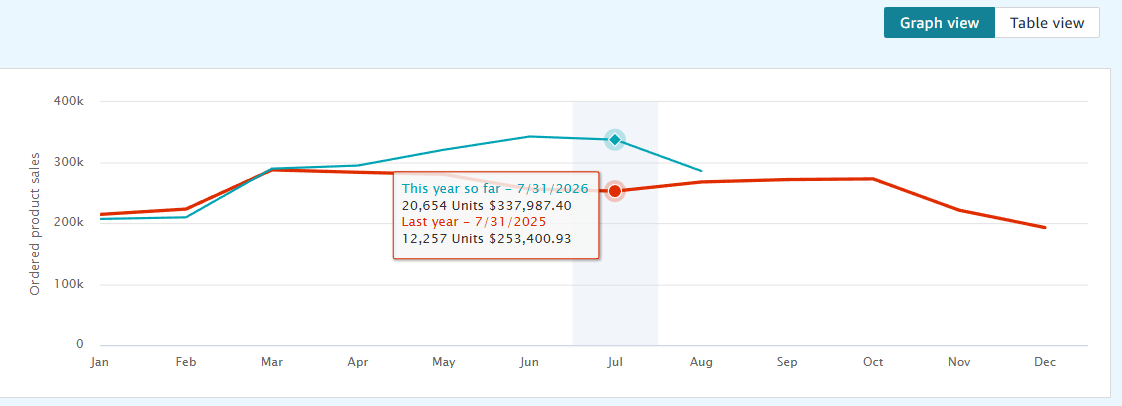
By July 31, 2026, ordered product sales reached $337,987.40, compared with $253,400.93 by the same date in 2025. Units increased from 12,257 to 20,654.
Why the result matters
PPC sales grew twice as fast as advertising spend.
From February through June, PPC-attributed sales increased 78.7% while PPC spend increased 38.6%. The improvement in ACoS confirms that the account was not relying on proportional spend increases to create the sales lift.
June also reported a 54.22% organic sales share. The new PPC structure supported catalog growth without turning the account into a paid-only business.
Discuss your Amazon PPC account
Find the product families your current structure is underusing.
Bring your catalog, current ACoS, growth goals, and account questions. We will start with the decisions that matter most.